
Introduction
For a long time, we have built our offices, schools, and community centers with a very "fixed" mindset. You build a wall, and that is where it stays for thirty years. But the way we live, and work is changing faster than ever. We are now facing a bit of a crisis in architecture: our buildings are stiff and unyielding, while our lives are fluid and unpredictable.
If you walk through almost any large office building, conference center, church, or school, you will see the same problem: Massive spaces that sit empty 90% of the week or giant auditoriums used only for special infrequent events. In the world of real estate, this represents "dead money." You are paying for the heat, the taxes, and the square footage of a room that is not doing anything for you. To solve this, we must stop thinking of walls as permanent borders and start thinking of them as tools that can be relocated, stored away, or deployed whenever the needs of the day change.
1. Breaking the Constraints.
Architects today find themselves in a demanding situation. They must stick to tight budgets, meet strict "green" environmental rules, and make sure people enjoy being inside the building. The old way of doing things—giving every single activity its own dedicated room—just does not work anymore. It is too expensive and it wastes too much space.
The solution is flexibility, but there is a catch. A room that can change has to be just as good as a room that is permanent. If you use a folding wall to split a spacious room into two, but you can hear every word of the meeting next door, that wall has failed. If the wall is heavy, ugly, or breaks down every three months, people will stop using it. The challenge is creating a space that does not feel like a compromise. When the wall is closed, it should create spaces that feel like a solid, high-end room. When it is open, it should be completely stored away out of sight.
2. Solving the Office Noise War
We have all seen the trend of "open-plan" offices. They look great in photos—lots of light, no cubicles, everyone "collaborating." But they can be a nightmare. They are often loud, distracting, and offer zero privacy. On the other hand, the old-school layout of tiny private offices feels like a maze and keeps people from talking to each other.
This is where movable walls come in as the ultimate "peacekeeper." Imagine a large main area that acts as a "town hall" for morning coffee and company-wide announcements. By lunchtime, you can slide out a few high-performance aesthetically pleasing acoustic partitions and turn that same area into three private classrooms or focus booths.
Instead of forcing people to change how they work to fit the building, the building changes to fit the people. This is especially important in schools, where a teacher might need a large accessible area for a group project for one hour and a quiet, divided space for a test.
3. The Bottom Line: Saving Money by Using Less
At the end of the day, money talks. Building a smaller building is the easiest way to save money, but you do not want to lose the ability to host large groups.
- For the Architect: If you can prove that one large room with a smart partition system can do the work of three separate rooms, you can shrink the building's footprint. This lowers construction costs and makes the project more sustainable because you are using fewer materials.
- For the Business Owner: If you are renting office space, every square foot costs you money. If your space can be configured into varied size areas, you can rent a smaller office but still have the "big room" feel by storing the moveable walls when you need a larger space for presentation or a holiday party. It makes a property much more attractive to modern tenants who do not want to be locked into a rigid floor plan.
4. More Than Just Walls: The Tech Behind the Move
Modern movable partitions are not the clunky, accordion-style plastic doors you might remember from old church basements. Today’s systems are engineering marvels.
- Smart Automation: Many new systems are fully electric. With the push of a button or a swipe on a tablet, the walls move into place and seal themselves automatically. This removes the "human error" factor where someone forgets to engage the bottom seal, which negatively affects the wall’s acoustic qualities.
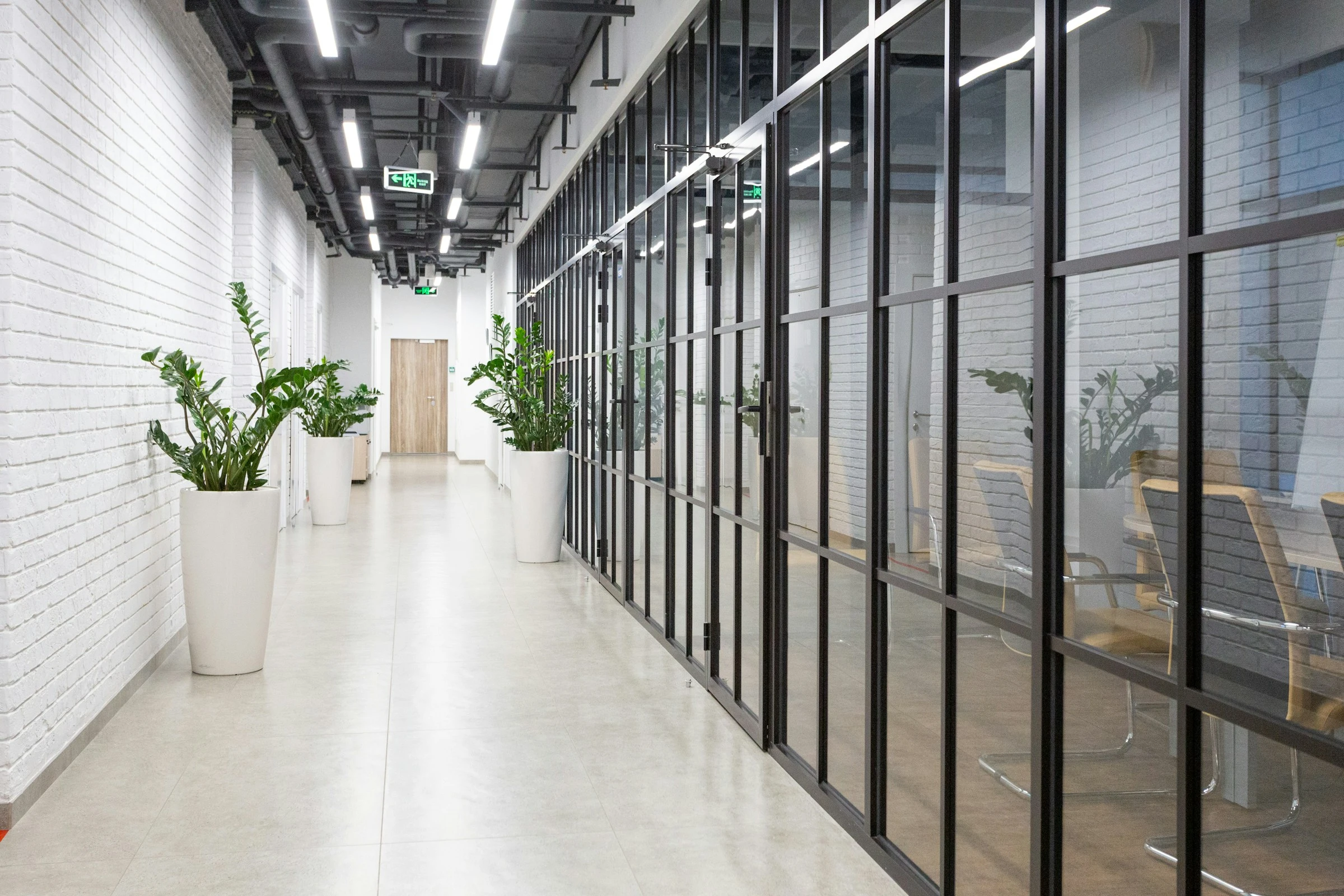
- Glass and Light: You no longer must choose between a wall and a window. Movable glass walls allow natural light to flow into the center of a building even when the rooms are divided. With "switchable glass," you can even turn a clear window into a frosted privacy wall with the flick of a switch.
- Integrated Tools: These walls can now be "working surfaces." You can specify walls that are also floor-to-ceiling whiteboards or have built-in TV screens and power outlets. The wall is not just a barrier; it is a piece of tech.
5. The Science of Silence (Acoustics)
The biggest "make or break" for any flexible space is sound. Sound is like water—it will find any tiny crack and leak through. If there is a one-inch gap at the bottom of a movable wall, you might as well not have a wall at all.
High-quality movable walls use a series of mechanical seals that are secured in place against the floor and the ceiling track. This creates a solid barrier that blocks noise. Architects look at the walls tested STC (Sound Transmission Class) rating. A high rating means you could have a loud birthday party on one side and a high-stakes board meeting on the other without any interference. This level of isolation is what makes a flexible building livable.
6. Sustainability and the "Long Game"
Sustainability is not about solar panels; it is about longevity. The most "green" building is the one that does not need to be torn down and rebuilt in ten years. When a company grows or changes its workflow, they usually must undergo a massive, dusty, expensive renovation to move permanent walls.
With a flexible wall system, you can "re-program" the building in an afternoon without creating any construction waste. This "futureproofing" ensures the building remains useful for fifty years instead of twenty, significantly lowering its total carbon footprint.
Conclusion
We are moving away from the era of "one room, one purpose." In a world where real estate is expensive and the future is uncertain; rigidity is a liability. Whether it is a hotel that needs to host three weddings at once or a tech startup that needs to pivot from an open collaborative hub to a private focus zone, the ability to change is the ultimate luxury.
By investing in smart, high-performance movable walls, we are not just buying partitions; we are buying "spatial insurance." We are ensuring that our buildings can grow, shrink, and adapt right along with us. The goal of modern architecture is no longer just to build something that stands still, but to build something that moves with the rhythm of the people inside it. Efficiency, privacy, and quiet—all available at the push of a button—is the new standard for the modern built environment.


